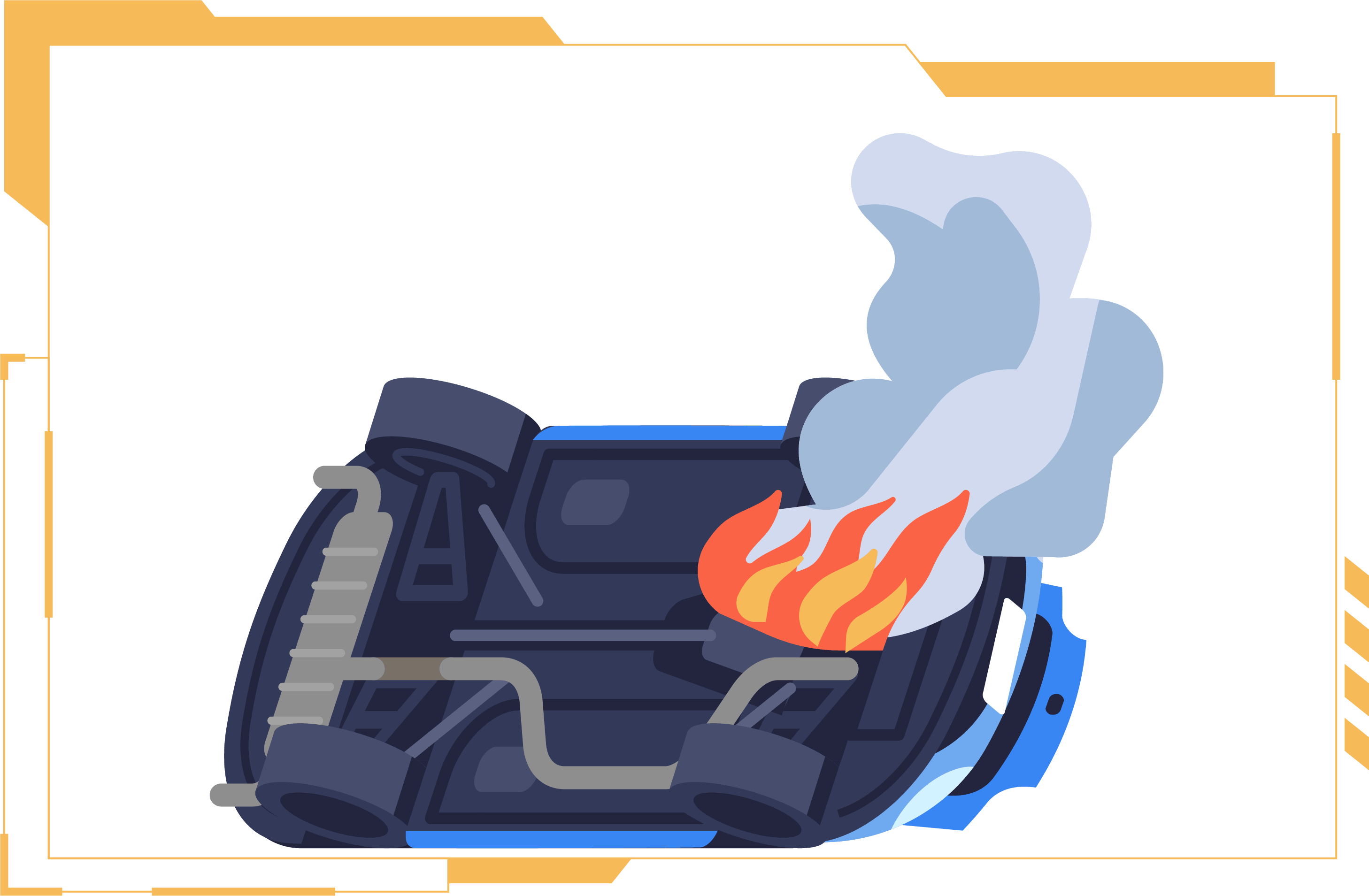
The virus Stuxnet was the first cyber-warfare malware that proved a piece of code could escape the digital realm and cause real physical destruction, in that case, on a nuclear facility. In this course you will learn to reverse-engineer, dissect, and understand disclosed cyber weapons like it, under the hood, using Python, Go, Rust, ARM assembly, C, C++, adversarial machine learning, and post-quantum cryptography, for national-security research.
Pick a level and watch how deep the research goes across the six domains this course covers. Every level keeps everything from the one before it.
Cyber warfare is the use of code as a weapon of state: to disrupt, degrade, or destroy an adversary's systems. This course dives deep into both sides of it, the forensic craft of dissecting a disclosed cyber weapon and the defensive discipline of stopping one, so you understand security the way only someone who has opened the hood can.
Stuxnet proved a program could reach out of the digital world and physically wreck hardware. You will study how that leap from bits to broken centrifuges actually works.
You cannot defend what you do not understand. You will reverse-engineer disclosed cyber weapons end to end, disassembling payloads, mapping delivery mechanisms, and tracing command-and-control traffic, and learn to think like the analysts who caught Stuxnet, so you can write genuinely defensive code.
This is security research in service of national security: red team thinking and blue team discipline, attack analysis and defence engineering, taught together on disclosed, documented case studies, and taught responsibly.
A cyber weapon is a system. You will take apart each disclosed component of Stuxnet-class malware and learn to recognize, analyze, and defend against it: the payload that did the damage, the delivery system that got it there unseen, and the command-and-control that kept its operators in charge of it.
Dissect how a documented payload attacked PLCs to disrupt their default operation, and how a second component ran a man-in-the-middle attack, spoofing the inputs coming from the PLC's I/O modules so its output did something other than the stock hard-coded logic said.
Trace how the payload replayed previously recorded input data, so the PLC logic and the human operator both believed all was well, and learn what telemetry would have exposed it.
Stealth. Analyze how a worm carried the main payload's routines, how it auto-executed its propagated copies, and how its rootkit component hid malicious files and processes from detection, and learn the forensic techniques that unwind each trick.
Precision. Study how the worm stayed dormant while it staked out the target, reactivating only when specific conditions were met, and the indicators that distinguish dormant reconnaissance from a false negative.
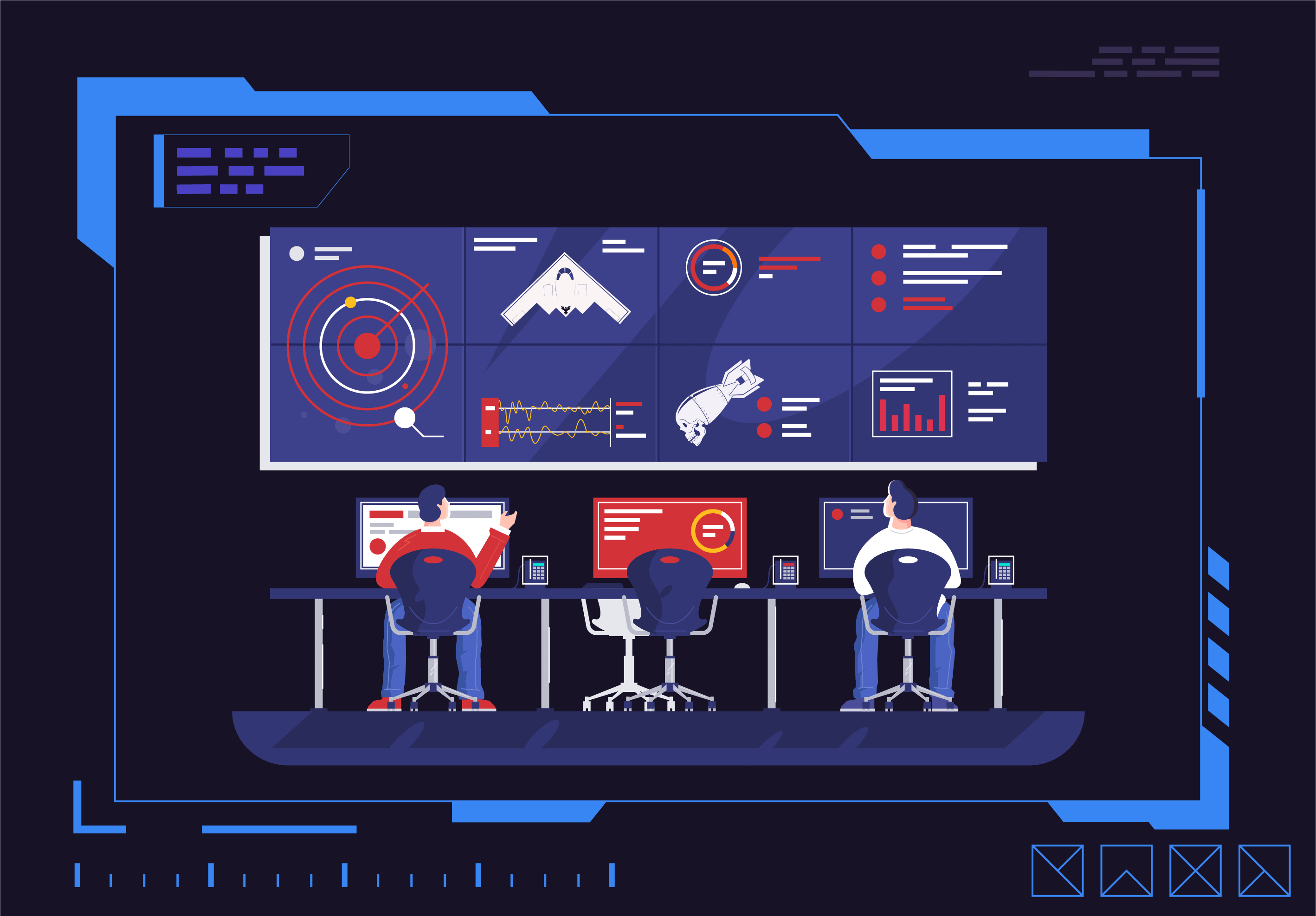
Study how the weapon phoned home, and how its fly-by-wire command-and-control let an operator flip a kill switch, track the worm's health, monitor its operations, and collect telemetry, so you can learn to fingerprint C2 traffic on the wire.
You will examine how the operators pushed live updates to the worm as they learned from its behaviour in hostile territory, and the network signatures that gave those updates away.
Four levels, each building on the last, with a specialization in Cyber Weapons Research and Analysis. Every level runs Monday to Friday, 10:00 to 19:00 India time (9 hours a day), as hybrid online-plus-onsite classes.
You will work through simulated, sandboxed environments modelled on real-world cyber attacks, defences, and strategies, built to sharpen your analytical skills, knowledge, and readiness against genuine threats.
Two teams: the Red Team attacks, the Blue Team defends. Learn attack techniques, defensive strategies, and why proactive security matters, from both sides of the wire.
Find and exploit vulnerabilities to capture digital flags across cryptography, reverse engineering, web and binary exploitation, adversarial AI, and post-quantum cryptography, sharpening pen-testing, forensics, and exploit development.
Study a sandboxed simulation modelled on a coordinated attack against a nation's critical infrastructure and financial systems. Learn to detect, contain, and recover from Fire-Sale-class cascading failures.
Find vulnerabilities, disclose them responsibly, and earn rewards. Learn to set up and operate bug-bounty programs for your own organization.
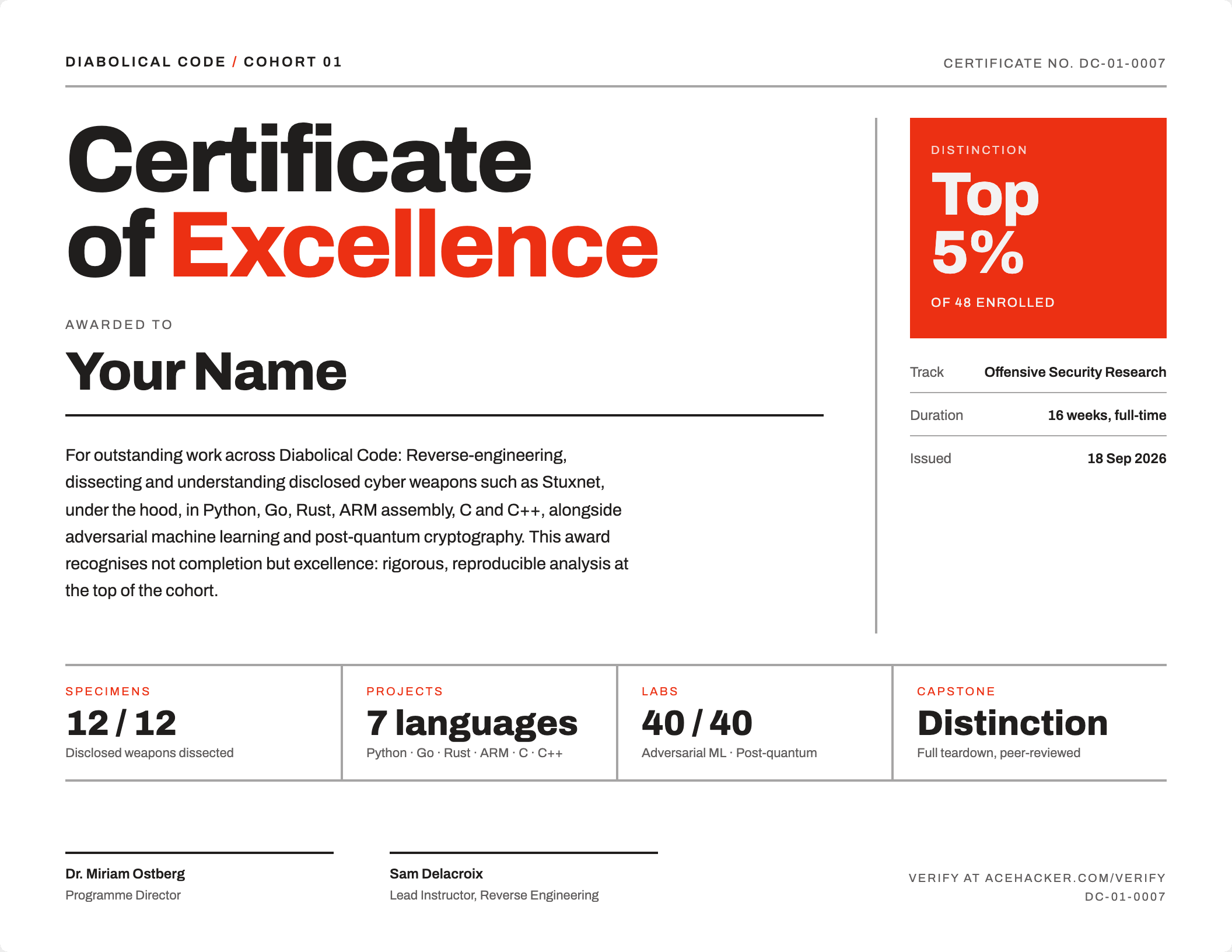
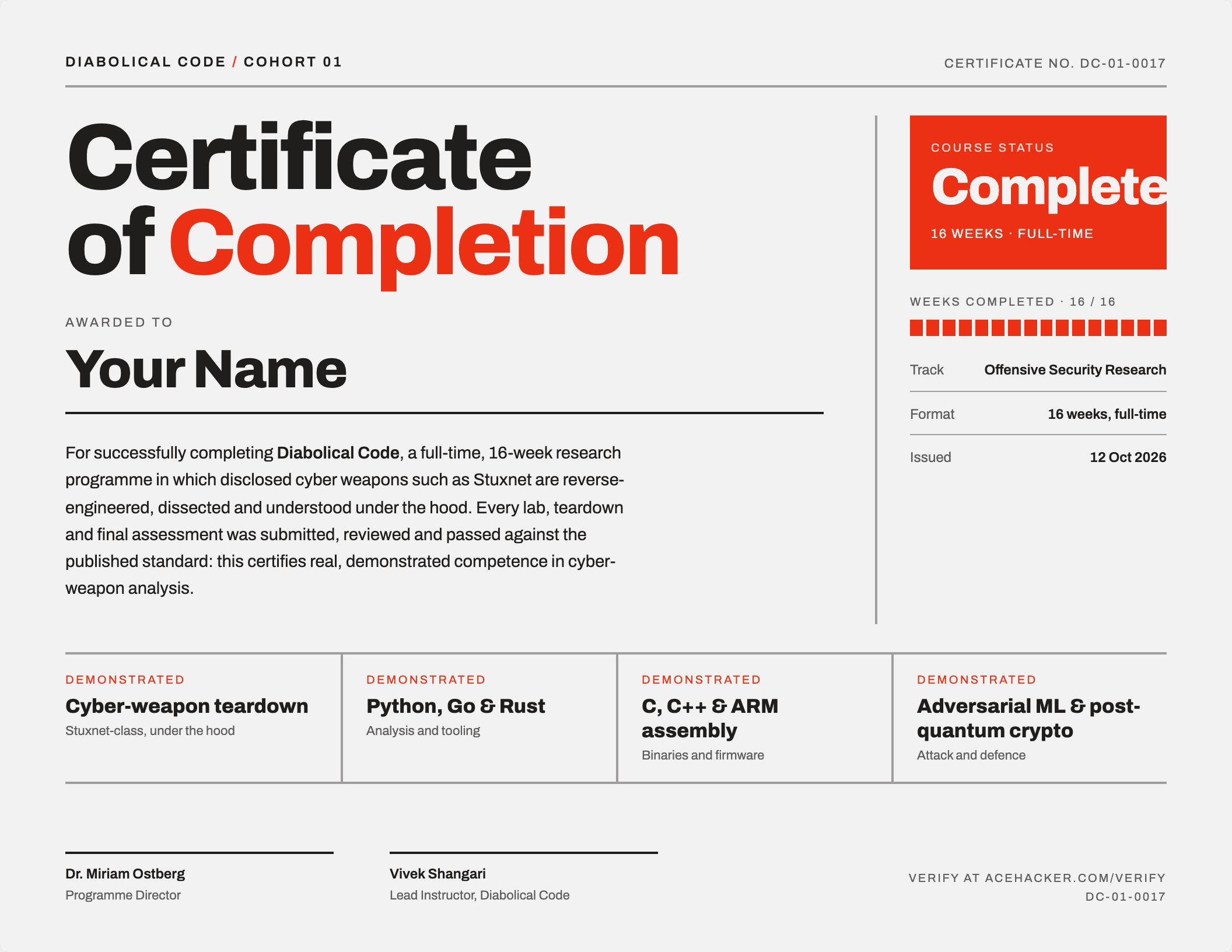
Based on your performance, you earn one of two certificates in Cybersecurity on successful completion of the course.
Awarded for standout performance across exercises, projects, competitions, and war games, recognition that you did not just finish, you excelled.
Awarded on successful completion of the course, marking your specialization in Cyber Weapons Research and Analysis.
The course requires no prior programming experience and no academic qualification. It starts from the basics and builds to advanced security research.
There is no right age to start learning. Batches may be grouped by age range or years of experience where it helps.
No prior programming or academic qualification needed. You start from basics and build a strong foundation plus advanced topics.
A gender-neutral learning and working environment. Identify however you choose, male, female, non-binary, or prefer not to say.
A hybrid / HyFlex classroom mixes onsite students with those joining virtually, from anywhere in the world.
Live, interactive sessions with real teachers, real snacks, and a room, physical or virtual, built for hands-on learning.
Code alongside the instructor and take your work home for revision. Expect fast internet, an amazing teacher, and yummy snacks with chai and coffee in class.
Your teachers' enthusiasm rubs off. Under their guidance you build not only the technical skill to succeed, but a love for the subject that lasts for years.
Arrive early for light snacks and beverages if you are onsite. The door closes sharp on time, and late entry after class begins may not be allowed.
3rd Floor, No. 670, RBI Layout Main Road, J.P. Nagar 7th Phase, Bengaluru 560 078, Karnataka, India.
The next cohort begins soon. Applications are currently closed, join the notify list and we will tell you the moment a batch opens.
| Level | Duration | Timing (IST) | Starts | Seats | Fee + GST | |
|---|---|---|---|---|---|---|
| L1 | 4 weeks | 10:00 – 19:00 | In progress | Classroom full | ₹ 71,366 | Notify me |
| L2 | 8 weeks | 10:00 – 19:00 | In progress | Classroom full | ₹ 1,42,733 | Notify me |
| L3 | 12 weeks | 10:00 – 19:00 | In progress | Classroom full | ₹ 2,14,099 | Notify me |
| L4 | 16 weeks | 10:00 – 19:00 | In progress | Classroom full | ₹ 2,85,466 | Notify me |
A cybersecurity expert safeguards digital systems, networks, and data from unauthorized access, attack, theft, and exploitation. Experts trained at Ace Hacker understand the technologies, tools, methodologies, and best practices to protect digital assets against a wide range of threats.
Yes, through four channels.
Challenge Ready: a thorough interview-prep module is built into the course, mock interviews, whiteboarding, a strong emphasis on data structures, algorithms, and algorithm analysis, plus handling impossible questions and Kobayashi Maru situations.
Demo Weeks: tech hiring events where organizations and startups discover talent. You showcase your work, interact directly with recruitment teams, and intriguing candidates are invited to interview.
Job Board: an alumni platform on an internal Slack channel and Discord server where companies regularly post openings, and mentors, alumni, and career coaches offer guidance.
Partner Connect: companies express interest in recruiting from Ace Hacker, and we connect applicants directly with their recruitment teams.
Yes, via EMI on specific bank credit cards, including SBI, Citibank, ICICI, Axis, Standard Chartered, Kotak Mahindra, Bank of Baroda, IndusInd, Yes Bank, HSBC, RBL, AU Small Finance, and One Card.
The EMI arrangement is strictly between you and the bank; Ace Hacker is not involved. Tenures range from 3 to 48 months depending on the bank, with interest rates varying accordingly. Select the EMI method during fee payment with an eligible card on hand, and review the bank's terms carefully.
Yes. Based on your performance, you receive either a Certificate of Completion or a Certificate of Excellence at the end of the course.
None. Diabolical Code requires no prior programming experience or academic qualification. It starts from basics and builds a strong foundation plus advanced topics in cybersecurity research and analysis. You are expected to bring your own device, online or onsite, code alongside the instructor, and continue your work at home.
These are live classes with real-time interaction with the instructor and classmates: personalized interaction, synchronous learning with the whole cohort, and immediate clarification of doubts in Q&A, AMA sessions, and office hours.
We strongly discourage missing class, this is where the real magic and mischief happen, but if something unavoidable comes up (like aliens abducting your Wi-Fi), we will share a recording so you can catch up.
We have a no-questions-asked refund policy. After attending at least two classes and before attending the third, if the course is not the right fit, we refund the full paid fees excluding non-refundable charges such as GST.
Refunds are processed within 14 working days of the request; it may take a few more days to appear depending on your bank. Any learning materials received should be returned in good condition within 5 working days. To initiate, email connect@acehacker.com from your enrollment address with your Student ID, full name, and course start date.
Yes. Scholarships are available under the Ekalavya Scholarship program.
To book a class for 25 or more students, email connect@acehacker.com, call (+91) 988.011.2117, or reach out via the contact form.
Vivek Shangari, Anshuman, Swati Garg, and Krishna Rao, assisted by six Teaching Assistants: Suman, Aarti, Jeremy, Biswa, Raghav, and Ismail.
Learn to dissect a cyber weapon, and to stop one. Earn your Security Researcher badge, and step out ready to understand what others only fear.